
Findings
The researchers developed a numerical framework for sediment transport in riverbeds containing multiple grain sizes. It couples large-eddy simulation, which represents turbulent flow, with a sediment module that tracks different size classes, their local proportions in the moving bed-load layer and changes in bed shape. The work is a preprint and has not been peer reviewed.
The team also conducted a laboratory flume experiment using mixed-size bed material. Measurements of grain-size distributions and bed elevations were used to evaluate the model. According to the abstract, the multi-grain model reduced the error in predicted maximum scour depth from 37.98% with a uniform-sediment model to 3.83%. For maximum deposition height, the reported error fell from 48.35% to 11.54%. These are comparisons with this experiment, not evidence that the model will achieve the same accuracy in natural rivers.
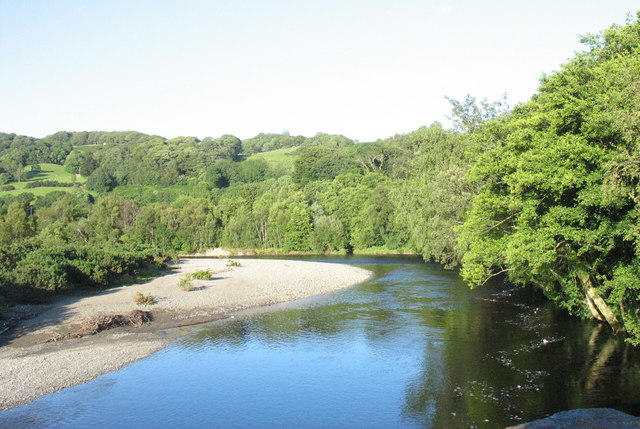
The validated framework was then applied computationally to large, meandering rivers. The simulations predicted sorting patterns in which coarser particles accumulated near erosional scour depressions while finer particles accumulated around depositional point bars. These patterns were simulation outputs rather than field observations reported in the abstract.
Why it matters
Natural riverbeds contain grains of different sizes, which interact differently with turbulent water and can become spatially sorted. Representing that variation may improve predictions of erosion, deposition and shifting riverbed topography. Such modelling could eventually inform research relevant to flood management, mitigation planning and infrastructure protection, although the abstract does not demonstrate operational or real-world benefits.
What remains uncertain
The abstract does not report the flume dimensions, number of experimental runs, sample size, range of grain sizes, flow conditions or statistical uncertainty. It also does not describe comparisons with alternative multi-grain models. The robustness and generalisability of the reported error reductions therefore cannot be assessed from the available material.
No field validation in a natural meandering river is described. River-scale predictions may be affected by conditions not detailed in the abstract, and successful agreement in a controlled flume does not establish accuracy across different rivers, floods or sediment mixtures. Independent evaluation and peer review would be needed before the framework’s practical reliability could be determined.